Written by Patricia Sims
This spring, Canadians learned from this report that a South African rhino rancher had gone to court seeking to export 479 rhino horns — the bulk of a 502-horn shipment — to a single address in Ontario. Not Vietnam. Not Hong Kong. Ontario.
For those of us who spent years fighting to close Canada’s borders to this trade, the news landed like a betrayal. Our efforts began in 2018 when we formed Ivory Free Canada, which was a coalition led by a group of Canadian animal-welfare organizations that included Elephanatics, World Elephant Day, Jane Goodall Institute, Humane Society International – Canada. In 2023, after a campaign that mobilized more than 700,000 Canadian voices, which was reported about, the federal government banned the import and export of raw elephant ivory and rhinoceros horn. When the regulations took effect in January, 2024, we believed we had locked the door. But the South African rancher Rockwood Conservation case is revealing something unsettling: nobody is certain the lock works. Former enforcement officials have observed that the regulation has never been tested, and that it remains an open question how officers would apply it if a shipment actually arrived. The rhino rancher now says his plans changed after Canada’s ban — proof the door has a deterrent effect. But a deterrent is not a guarantee, and 479 horns were pointed squarely at it. South Africa, for its part, is now petitioning its own Supreme Court of Appeal simply to establish what its treaty obligations mean in domestic law.
Seven years ago, Jane Goodall wrote an op ed and asked a blunt question: why hasn’t Canada banned the elephant ivory trade?
I launched World Elephant Day on August 12, 2012 asking a similar question: why hasn’t the world upheld its ban on the elephant ivory and rhino horn trade?
The international commercial ivory trade was banned in 1989, yet in 2008 a one-time sale of 108 tonnes of government-owned ivory from Botswana, Namibia, South Africa and Zimbabwe was approved for domestic markets in China and Japan. I could not understand the logic. Ivory that had been seized or stockpiled in the name of protecting elephants was being sold into countries where consumer demand had helped drive the slaughter that prompted the ban in the first place. It seemed inevitable that reopening a legal market would provide cover for illegal ivory and place elephants at even greater risk. Tragically, that is what followed. The sale ignited an expanding ivory market in China, and between 2010 and 2012 more than 100,000 African elephants were poached. Investigations found a significant rise in illegal ivory trafficking, with little evidence that the proceeds received by the four African countries delivered the promised benefits for elephant conservation.
As the scale of the crisis escalated, I believed the world needed a single day to unite people around the urgent threats facing elephants. World Elephant Day was born from that conviction.
I could not have imagined then that it would grow into a global movement, bringing together conservation organizations, governments and millions of people each year in support of elephant protection.
There have been victories since. China closed its ivory market in 2017, and Jane Goodall’s words helped galvanize the movement that led to Canada’s ban in 2024. This August 12 will be the first World Elephant Day without her. I have wondered what she would make of this moment: a hard-won ban, still untested, with hundreds of rhino horns nearly at the threshold.
The forces driving the ivory and rhino horn trade have not disappeared. They have evolved into transnational criminal networks that exploit legal grey zones, commingle illicit wildlife products with legitimate trade and probe treaty exemptions for weaknesses. Wildlife crime is an act of economic and ecological sabotage – and Canada is not immune. Wildlife trafficking generates an estimated US$20-billion annually and is linked to syndicates that move drugs, arms and people. Yet the Convention on International Trade in Endangered Species (CITES) remains a trade-permit system. We are confronting 21st-century organized crime with paperwork.
A stronger response is within reach. This October, in Vienna, parties to the United Nations Convention against Transnational Organized Crime will consider a proposed protocol treating wildlife trafficking as serious organized crime. It would strengthen penalties and provide tools such as extradition, mutual legal assistance and joint investigations to help build a stronger global response to the criminal networks that continue to profit from the destruction of wildlife.
Canadians proved in 2023 that they will not tolerate this trade within our borders. Now we must take that conviction to the United Nations, and Canada should support and co-sponsor the proposed protocol when states gather in October.
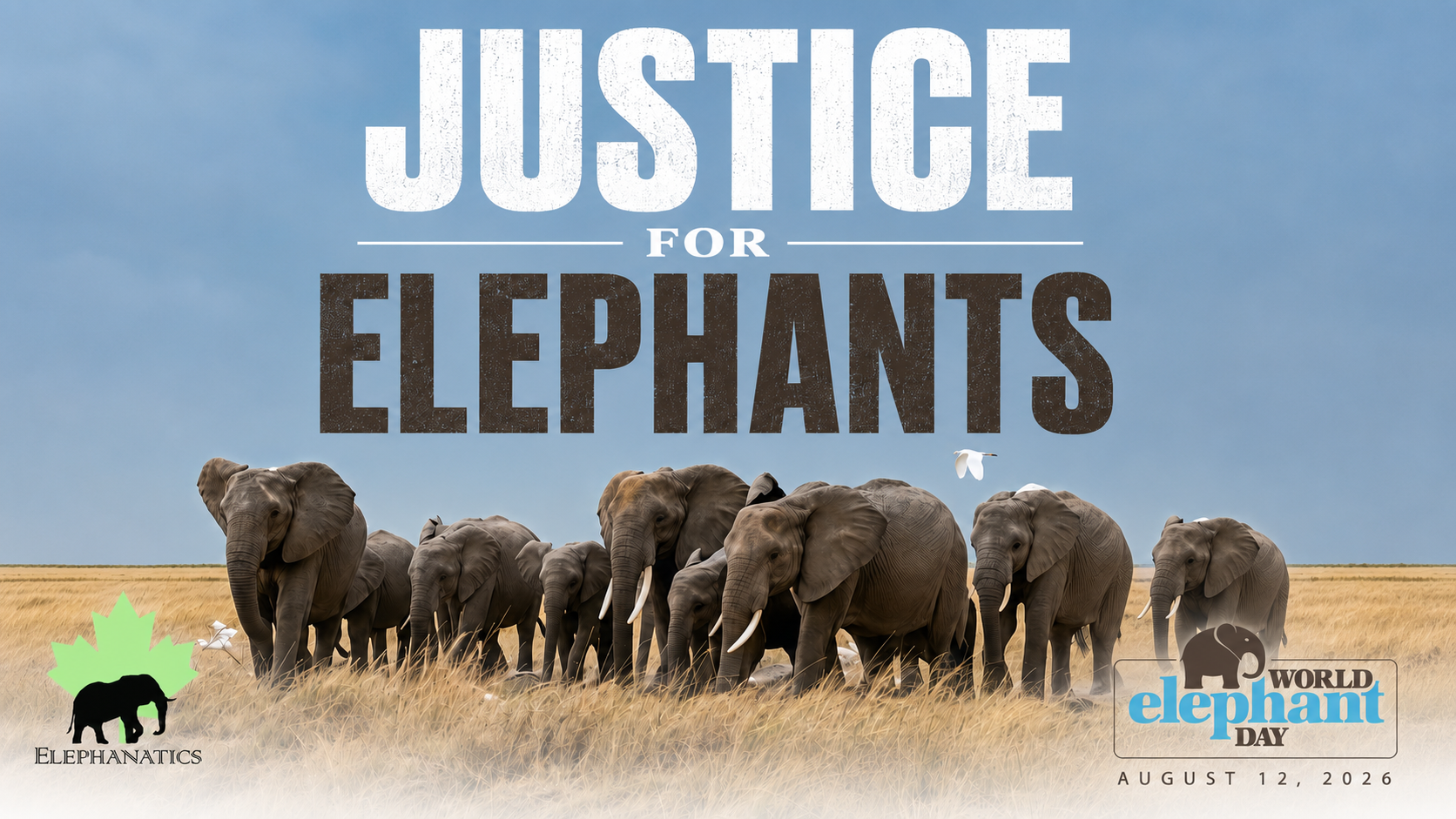
Jane Goodall chose elephants, not ivory. On this first World Elephant Day without her, the truest tribute is to finish the work, choose justice for elephants, and ensure that crimes against them are treated as crimes. Fellow Canadians, please join our appeal to the Canadian government. Click on this link to support the UNTOC Protocol CoP13 proposal and give wildlife crime the severity that it deserves.
___________________________________________________________________________________________________________________________________________
Patricia Sims is a Canadian conservationist, filmmaker, and the co-founder and executive director of World Elephant Day.